How long does it take to build a habit? (It's not 21 days)
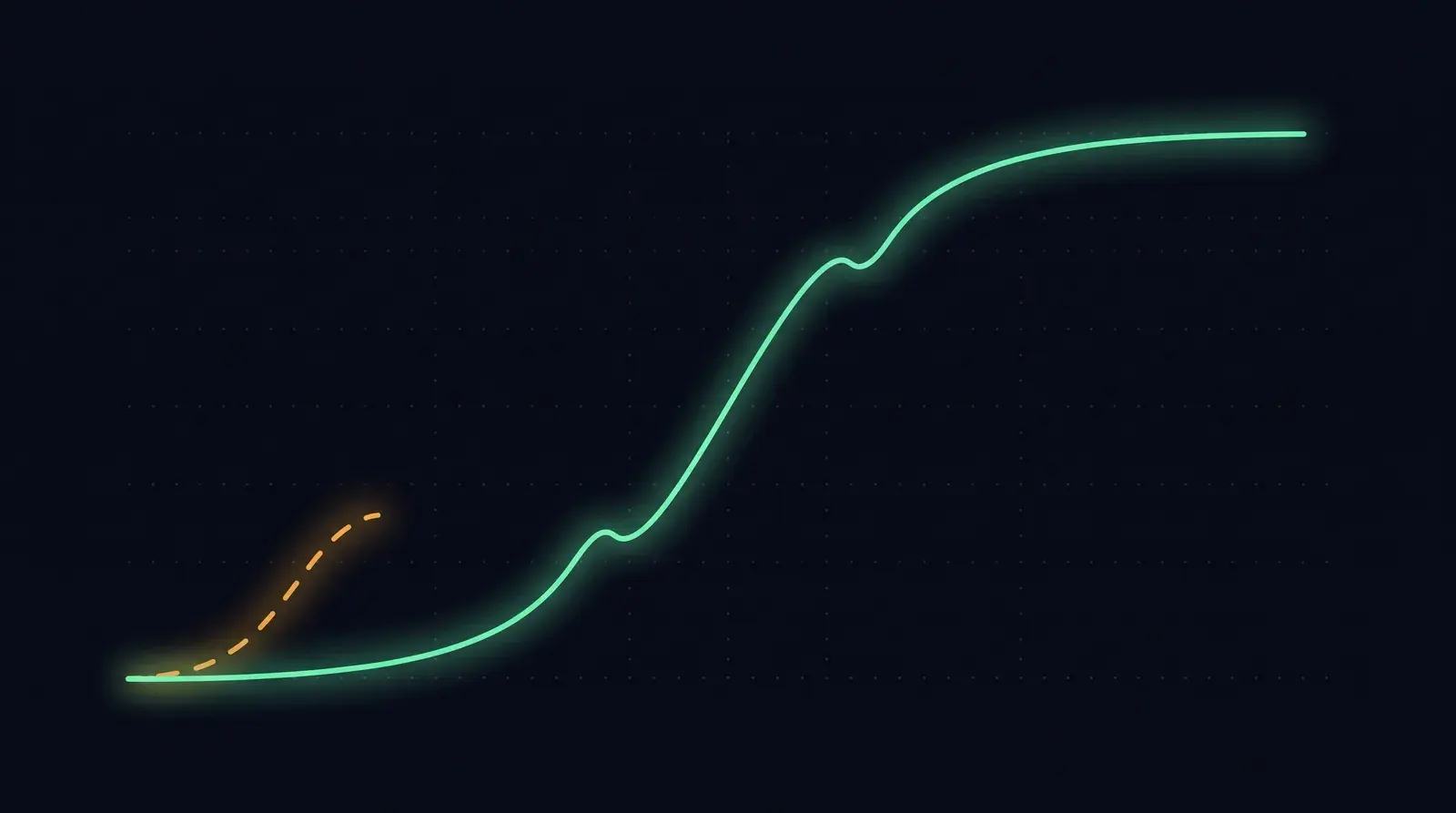
You have heard the number. Twenty-one days to build a habit. It is printed on fitness plans and productivity apps and the inside of your own head, and it is the reason you have quit so many things on day nine feeling like a failure. You white-knuckle a new routine for three weeks, wait for it to click, and when it does not, you conclude the problem is you.
The problem is not you. The number is wrong, and the framing behind it, that a habit is a countdown you finish, is worse than wrong. It is the exact belief that makes habits collapse. Here is where 21 days actually came from, what the research really found, what your number depends on, and why the whole "how many days" question is the wrong one to be asking.
Where the 21-day myth came from
The 21-day rule is not a study. It is a misquote of a plastic surgeon.
In 1960, Maxwell Maltz published a self-help book called Psycho-Cybernetics. He noticed that his patients seemed to take "a minimum of about 21 days" to get used to a new face after surgery, or to stop feeling a phantom limb. That was an observation about adjusting to a changed body, not a measurement of habit formation. And notice the exact words: a minimum of about 21 days.
Over the following decades, self-help authors quoted Maltz, then quoted each other quoting Maltz, and somewhere in the chain "a minimum of about 21 days" lost the "minimum" and the "about" and became "21 days to form a habit." A soft observation about a floor turned into a hard promise about a finish line. There was never any data behind it.
What the research actually found
The real number comes from a study most people have never heard of. In 2010, Phillippa Lally and colleagues at University College London followed 96 people who each picked one new daily behavior, something like drinking a glass of water with lunch or doing fifty situps, and tracked how automatic it felt over 12 weeks.
Two findings should be printed over every habit-tracking app ever made.
First, among the behaviors that did become automatic, the median time was 66 days, not 21. More than three times the myth.
Second, and more important: the range was enormous. Individual behaviors took anywhere from 18 days to 254 days to become automatic. There is no single number. Someone in that study built a habit in under three weeks. Someone else, doing their honest best, needed eight months. Both are normal. If you have been holding yourself to 21 days, you have been failing a test that was rigged from the start.
There is a third finding that quietly dismantles the whole streak mentality. Missing a single day did not meaningfully derail the process. Automaticity built up along a curve that a one-day gap barely dented. The habit did not reset. It just kept climbing.
What actually sets your number
If the range runs from 18 to 254 days, the useful question is not "how long" but "what moves me toward the fast end." Four things do most of the work.
Complexity. Drinking water after lunch is a fast habit because it is one small action attached to something you already do. "Do a full workout" is not one action, it is a chain of decisions, and every extra link slows the curve. The simpler the behavior, the faster it automates.
Effort price. A habit that pays you back immediately, a coffee, a stretch that feels good, builds faster than one whose reward is slow and abstract. This is the same reason cheap dopamine hijacks you so easily: instant reward carves the groove fastest. Effortful habits are worth more and take longer precisely because the payoff is delayed. Knowing that in advance stops you from quitting when week three still feels like work. It is supposed to.
A consistent cue. What the research found moves automaticity fastest is how consistently the behavior actually gets repeated, and a stable trigger is the cheapest way to make that repetition happen: after lunch, after I brush my teeth, when I sit down at my desk. A habit with no fixed cue is a decision you have to make from scratch every day, and decisions are where things die. Bolt the new behavior onto an existing one and the cue does the remembering for you.
Honest consistency, not perfect consistency. Doing it most days moves the curve. Doing it perfectly for nine days and then quitting does not. This is why the all-or-nothing streak is such a trap, and why consistency is a design problem, not a character trait: the goal is a high batting average over months, not an unbroken chain that one bad Tuesday snaps to zero.
Why the countdown framing sabotages you
Here is the deeper problem with "21 days," or even with "66 days." Both turn a habit into a deadline, and a deadline has a finish line, and a finish line is exactly what a habit must not have.
Watch what the countdown does to your head. You are not building a behavior, you are serving a sentence, waiting for day 22 to arrive and set you free. So you push through on willpower, which is fine for a sprint and useless for a life, and this is precisely why motivation always runs out before the habit sets in: you have priced the whole project in a currency that expires. Then day 22 comes, nothing magical clicks, because nothing was ever going to click, and the let-down reads as failure. Or the habit does hold for three weeks and you mentally cross the finish line and stop, because the countdown told you the work was done.
Real habits do not graduate. They just get cheaper to repeat, slowly, along a curve with no ceremony at the end. A number that promises a finish line is setting you up to quit at it.
Stop counting days, start counting the balance
So throw out the calendar. You do not need a behavior to become fully automatic before it starts paying you, and you do not need an unbroken streak to prove it is working. What you need is a way to see the trend without a deadline hanging over it.
That is exactly what Baseline is built for. It runs on a build vs drain model instead of a streak. Every evening you log what happened: builds on one side, the effort-priced things you are trying to make routine, drains on the other, the cheap stuff. Each entry carries a weight and the day collapses into one net number.
That reframe fixes everything the countdown broke. There is no day 22 to fail on, because there is no finish line, only a trend. Missing a day does not snap a streak to zero, it just dips the number, exactly as the research says a single miss should barely matter. And on day 40, when the habit still takes effort and the 21-day myth would have you convinced you are broken, the chart shows you the truth the feeling hides: the behavior is showing up more often than it used to. You are not counting down to a finish. You are watching a floor rise. That is what building self-discipline as a system rather than a trait actually looks like from the inside.
Where to start
Not with a 21-day challenge. Not with a 66-day one either.
Pick one behavior, and make it small enough that a bad day cannot stop it: not "work out," but "put on my running shoes." Bolt it to a cue you already have, right after an existing daily anchor, so you never have to remember it cold. Then tonight, log it, as a build, and log it honestly whether the day was good or ugly. Tomorrow, same cue, same small thing, same honest log.
Do not check the calendar. Your habit does not care what day it is, and neither should you. Somewhere between day 18 and day 254 it will quietly stop taking effort, and you will only notice in hindsight, because you were watching the number climb instead of waiting for a countdown to end.