Instant vs delayed gratification: the skill nobody actually taught you
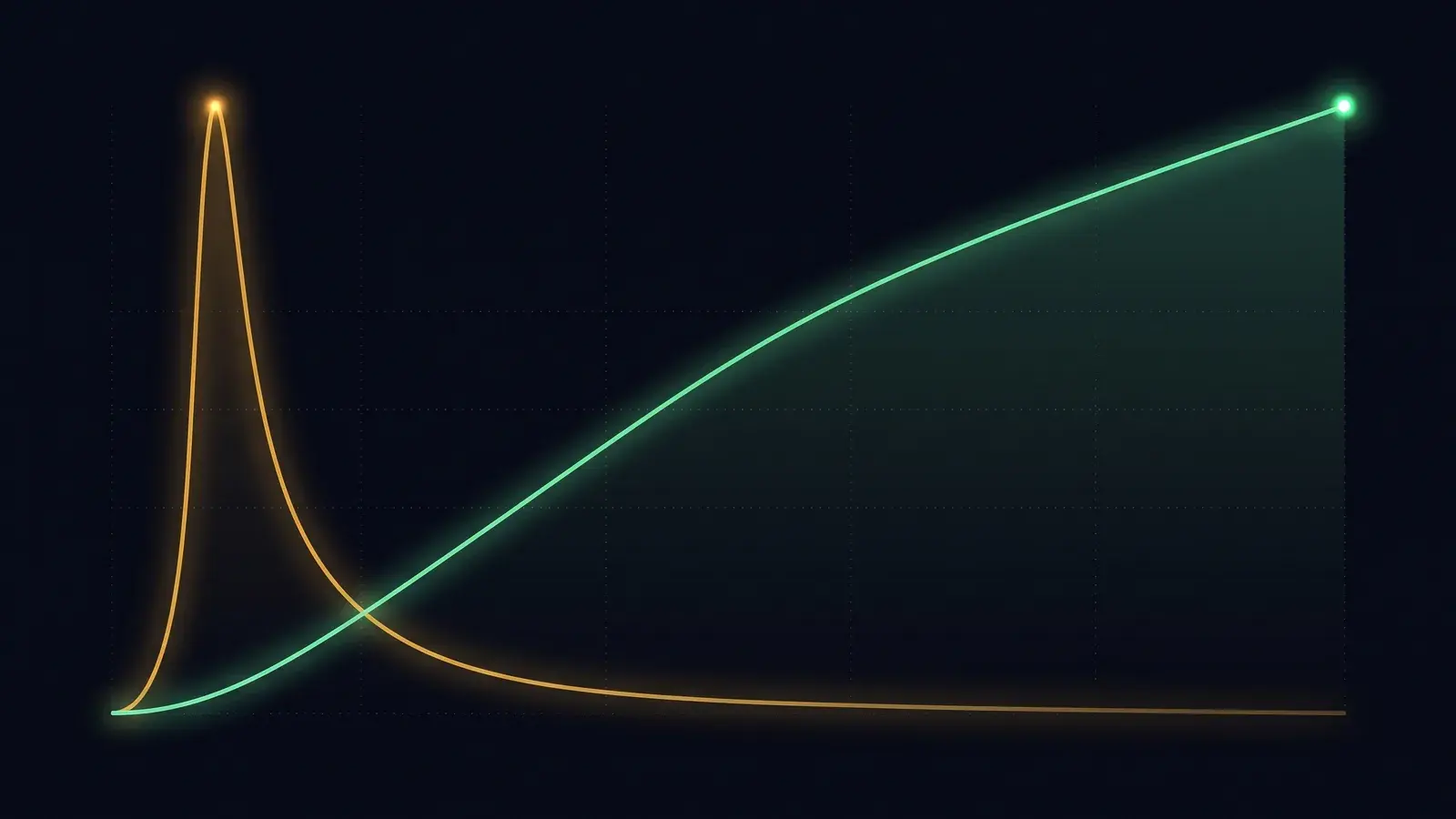
It is 9pm and you know exactly which of the two options is the better one. You know it the way you know your own address. Then you take the other one, without much of a fight, and spend a few minutes afterward wondering what is wrong with you.
Nothing is wrong with you. You are running the same discount function every human brain runs, and nobody ever showed you how to work with it. The story you were handed instead was about character: some people have self-control, some people do not, and a test with a marshmallow can tell which one you are by the age of four.
That story is wrong in a specific and useful way.
The test that turned into a verdict
Stanford, late 1960s. Walter Mischel sits a preschooler down with a marshmallow and an offer: eat it now, or wait about fifteen minutes alone in the room with it and get two. Some children hold out. Most do not.
The famous part came later. Follow-up work in the 1980s and 1990s reported that the children who had waited longer went on to score better on the SAT, and the finding escaped the lab and became something much bigger than it was: proof that self-control is a fixed quantity, visible in a four year old, quietly determining the rest of a life.
That is the version everyone knows. It is also the version that did not survive.
What happened when someone ran it again
In 2018, Tyler Watts, Greg Duncan and Haonan Quan published a conceptual replication in Psychological Science, using a sample far larger and far more diverse than the original group of Stanford preschoolers.
They did find a link. An extra minute of waiting at age four predicted roughly a tenth of a standard deviation more achievement at fifteen. But the raw correlation came in at about half the size of the one the original studies reported, and once they controlled for family background, early cognitive ability and home environment, it shrank by around two thirds. What remained was real, small, and largely accounted for by circumstances that have nothing to do with a child gritting their teeth.
A second study lands harder. In 2013, Celeste Kidd and colleagues ran the marshmallow task, but first gave the children a reason to trust or distrust the adult running it. One group had just watched a promised set of art supplies fail to materialize. The other had seen the same promise kept. Then came the marshmallow.
In the unreliable group, one child out of fourteen waited the full fifteen minutes. In the reliable group, nine out of fourteen did. Same task, same age, same marshmallow. The sample was small, twenty-eight children in total, so hold the exact numbers loosely. The direction is harder to wave off: a child who eats immediately in a world where promises do not hold is not failing a self-control test. They are answering it correctly.
Which reframes the whole thing. Waiting is not a virtue some people were issued at birth. It is a bet, and you take it when the payoff looks real.
Your brain discounts the future, steeply
Underneath the test is a mechanism that is not mysterious at all. A reward loses value the further away it sits, and it does not lose that value in a straight line. It drops off a cliff near the front edge and flattens out in the distance.
You can watch this happen in yourself with two questions.
Would you rather have 100 dollars in twelve months, or 110 dollars in twelve months and one week? Almost everyone takes the 110. An extra week is nothing when you are already waiting a year.
Now: would you rather have 100 dollars right now, or 110 dollars in one week? A lot of people flip and take the 100. It is the same week. It is the same extra ten dollars. The only thing that changed is how close the near option sits to right now.
That reversal is the entire problem, compressed into one line. Nothing is wrong with your values at 9pm. The thing you actually want is still the thing you want. It is just far away, and the other one is in your hand.
Why a flat baseline makes the wait unbearable
Now stack the modern environment on top of that.
Cheap dopamine is reward with the delay engineered out. That is the entire product. The scroll, the autoplay, the delivery app, the notification: each one is built so the gap between wanting and getting rounds down to zero. Nothing worth building has that property. Training pays in months. A skill pays in years. Reading pays quietly and never once announces it.
So the comparison is rigged before you even make it. And it gets worse as your baseline sinks, because a reward system tuned by constant instant hits stops registering slow ones at all. The delayed option does not just feel further away. It feels smaller. Effort stops producing a signal you can detect, which means the wait now costs you something real and pays you nothing you can feel.
This is the honest reason "just delay gratification" fails as advice. It assumes both options are visible. When the baseline is flat, only one of them is.
The part of the marshmallow test everyone skipped
Here is the finding that did survive, and it is the one worth having.
Mischel watched what the successful children actually did in that room. They did not sit and stare at the marshmallow with a clenched jaw, out-toughing it. They looked away. They covered their eyes, turned their chairs around, sang, kicked the desk, talked to themselves. Some reframed the thing on the table until it stopped being food at all: a picture of a marshmallow, a cloud, not a real one.
The children who lost were, overwhelmingly, the ones who stared.
So the skill was never endurance. It was attention. The ones who made it rearranged what they were looking at until the temptation went quiet, and then waiting was not hard, because there was nothing left to fight.
That is a very different claim than the one the internet took from this study. Endurance is a trait you either have or lack. Attention is a skill, and skills are trainable.
How to shorten the gap
Three moves, in order of leverage.
Put distance on the instant option. Because discounting bites hardest at the front edge, you do not have to ban anything. You only have to move it out of the zero-delay slot where it wins automatically. Phone in another room during the block. Logged out, not just closed. App off the home screen, so opening it takes eight seconds of deliberate effort instead of a thumb landing where it always lands. A ten minute rule works on the same principle: you can have it, in ten minutes. Most of the pull does not survive the ten minutes, because most of it was never about the thing. It was about the thing being instant. This is the same lever behind cutting screen time and it is why willpower-based limits fail while friction-based ones hold.
Shorten the delay on the slow option. You cannot make the gym pay off physically in a day. You can make it pay off on the scoreboard in a day. Logging a build the moment you finish it puts a real payoff at the front edge, where your discount function can actually see it, without lying to yourself about the physical timeline. This is the entire point of running a build vs drain ledger: the effort resolves into a number today, not in six months.
Train the rep. Every deliberate delay is one repetition, and the count is what moves. Start where you can win: the second coffee, the phone at the table, the episode after the one you meant to watch. You are not building moral fiber. You are practicing the attention move, over and over, until doing it costs less. And when you lose one, log it and keep going. A single miss is a data point, not a verdict, and treating it as a verdict is how most attempts die on day nine.
On Baseline, this is the whole design. You log builds and drains, the day collapses into one net number, and the reward for a hard choice arrives the same evening you made it rather than sometime next spring. Your rank climbs as the days accumulate: Soft, Iron, Steel, Tungsten, Titanium, Carbon, Diamond. The rank never resets, which is the point. It is the long payoff, made out of short ones, sitting somewhere you can see it while you are still deciding.
The bottom line
The marshmallow test never found a trait in you. Run properly, it mostly found the circumstances a child grew up in and how much reason they had to believe a promise. Half the effect vanished on replication, and most of what was left belonged to something other than willpower.
What it did find, in the footage nobody quotes, is that waiting is an attention problem. The children who won were not tougher. They were looking somewhere else.
You are not weak at 9pm. You are standing in front of one reward with the delay stripped out and another one parked six months away, and losing that comparison is the expected outcome, not a character flaw. Move the near thing further back. Pull the far thing closer with a scoreboard. Then take the rep again tomorrow, because discipline is a system, not a trait, and this is one of the parts you can actually build.